

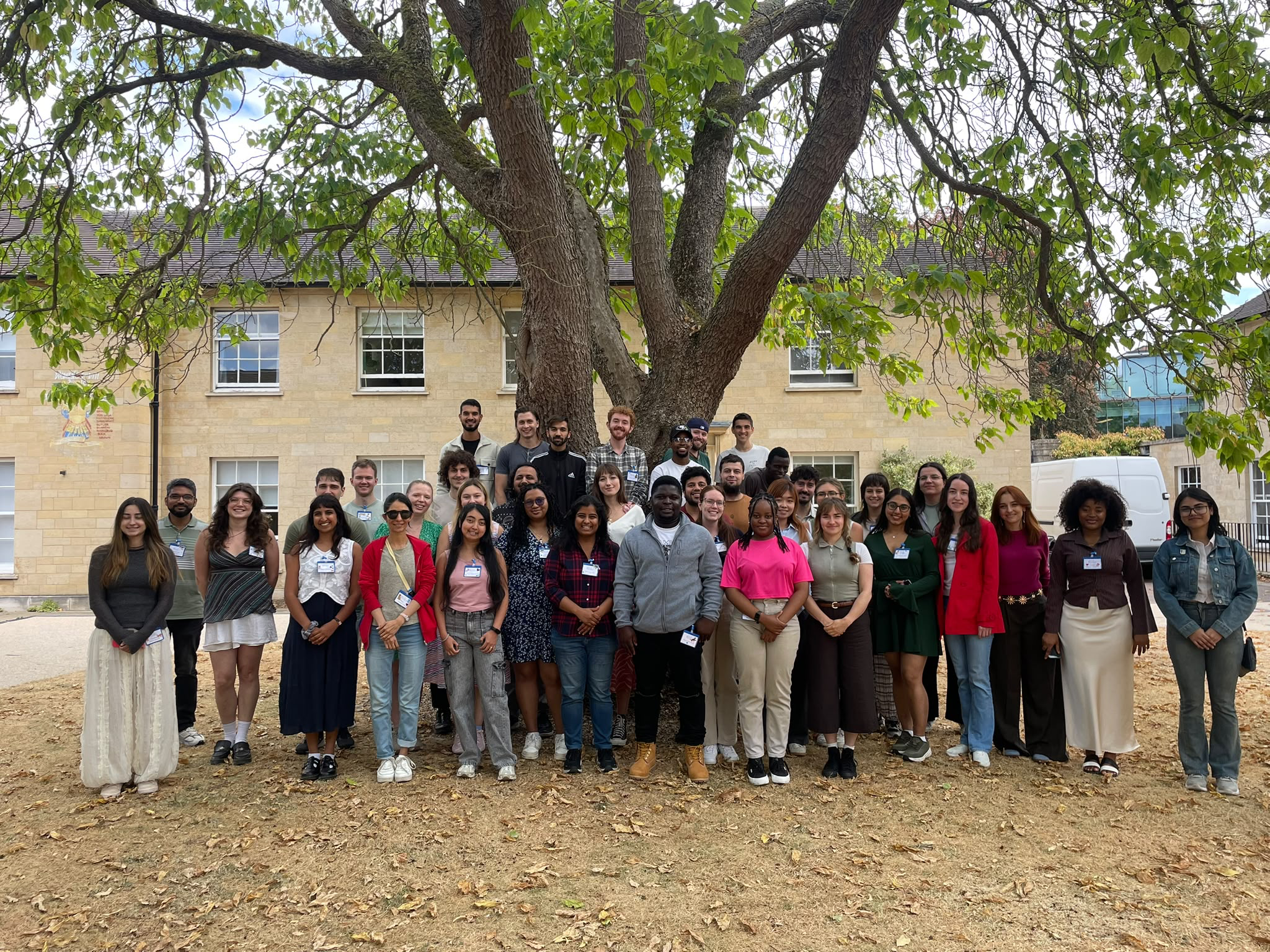
The 54th edition of the Young European Radio Astronomers Conference (YERAC) was hosted in Oxford from the 17th-21st August to great success. This year’s edition was attended by 40 early career researchers (ECRs), representing institutes from 12 countries, with participants from at least 20 countries represented. YERAC is a unique conference in the landscape of ECR meetings, explicitly set up to bring together young radio astronomers working in European institutes, observatories and collaborations to provide them with early opportunities for interactions with peers. This year’s conference took place primarily in the Astrophysics department in Oxford, with 1 ‘away day’ of the meeting taking place at Green Templeton College, home to the Radcliffe Observatory, the historic home of astronomy in Oxford.
In keeping with the YERAC ethos we heard talks from every participant, each of whom gave a 12-minute talk followed by questions. For some, particularly the MSc students, this was their first time giving a science presentation to an audience outside their host institution. The range of astrophysics being studied was immense, demonstrating the diversity of physics that is studied in radio astronomy. We heard from nearby planets to 21-cm cosmology via pulsars, local galaxies, AGN and just about everything in-between. In addition to these astrophysics talks, there was ample representation of machine learning applications, software suites and simulation developments that are accelerating and informing what we can learn from our observations, whilst new instrumentation was presented for cosmology and maser monitoring systems.
We were also to capture a snapshot of what ECRs want to see in astronomy moving forwards, holding a “speed-dating” event discussing positive initiatives from our departments, common issues faced and future prospects. Major themes developed around seeking long-term funding for telescopes, as well as ambitious hopes for upcoming and future observatories (on the lunar far side, for example!). Closer to home, many people voiced how ECR events really helped them feel connected with the international network of peers in radio astronomy, whilst job prospects were a constant source of worry.
Finally, we were honoured to hear from Dame Jocelyn Bell-Burnell, whose story and career serves as an inspiration for many (radio) astronomers.
In summary, YERAC2026 was a resounding success and we the organisers strongly encourage any prospective hosts for next year to get in touch soon for what will undoubtedly another stellar edition of the best conference in radio astronomy!
Image Credit: University of Oxford