

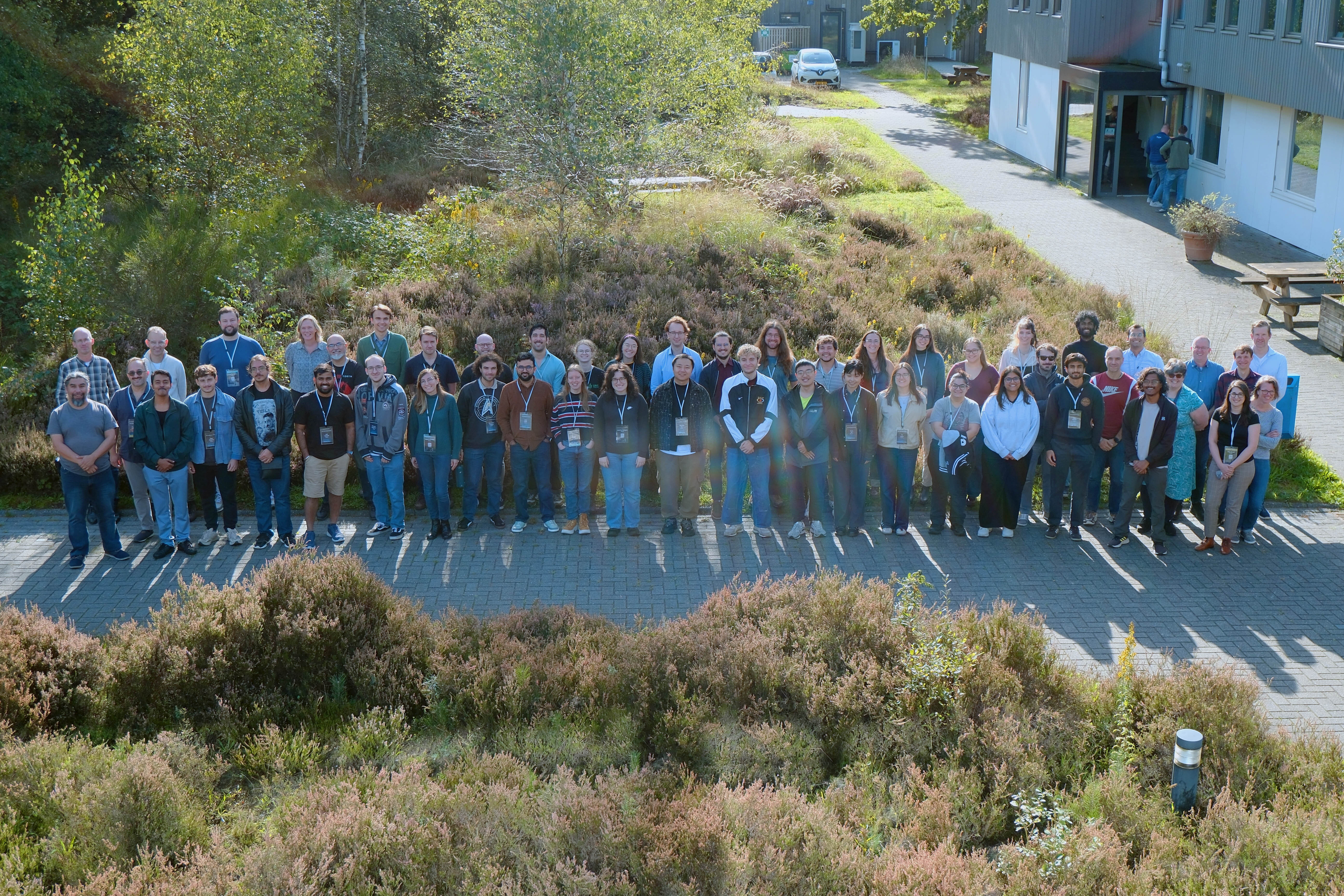
The 8th LOFAR Data School (LDS) took place from September 16 to 23, 2026 at ASTRON in the Netherlands, bringing together around 40 participants for an intensive week of hands-on training in the generation and analysis of LOFAR science-ready data.
The diverse program covered techniques for processing and analyzing both interferometric and beam-formed observations across a broad range of science cases. Topics included wide-field imaging, extended faint sources, polarized emission, exoplanet searches, solar emission, ionospheric science, pulsars, and high-time-resolution phenomena.
To complement the lectures and tutorials, the lecturers designed ten mini-projects, giving students the opportunity to work directly with LOFAR data. Participants worked on their preferred projects in small groups throughout the week, with guidance and mentorship from the lecturers, and presented their findings on the final day.
For the first time, the LOFAR school program extended over the weekend, giving participants additional time to network with fellow students and the lecturers, as well as to work on practical exercises. The school program also included a visit to the LOFAR core site, the Westerbork Radio Synthesis Telescope, and the Dwingeloo Radio Telescope.
LOFAR Data School continues to provide an important platform for training the next generation of low-frequency radio astronomers.
LDS 2026 is sponsored by ASTRON, LOFAR ERIC, and the Astrophysics Centre for Multi-messenger Studies in Europe (ACME). The ACME project has received funding from the European Union’s Horizon Europe Research and Innovation programme under Grant Agreement No 101131928.
Image Credit: ASTRON