

A major ALMA survey has revealed widespread methanol maser emission around young stars and achieved the first detection in space of fully deuterated methanol (CD₃OD). The findings provide new insights into the chemical processes taking place during the earliest stages of star formation and the origins of molecular complexity in emerging planetary systems.
The ALMA COMPASS Large Program studied 11 nearby, Sun-like protostars using more than 100 hours of telescope observations. Its first results, published in seven papers in Astronomy & Astrophysics, demonstrate the power of sensitive radio observations to explore the chemical composition of young stellar systems.
One of the key discoveries was the detection of fully deuterated methanol around the protostar IRAS 4A2 in the Perseus molecular cloud. The study was led by Dr Arnaud Belloche of the Max Planck Institute for Radio Astronomy. Other results show that methanol maser emission is more widespread around low-mass protostars than previously known.
Read the full ALMA press release.
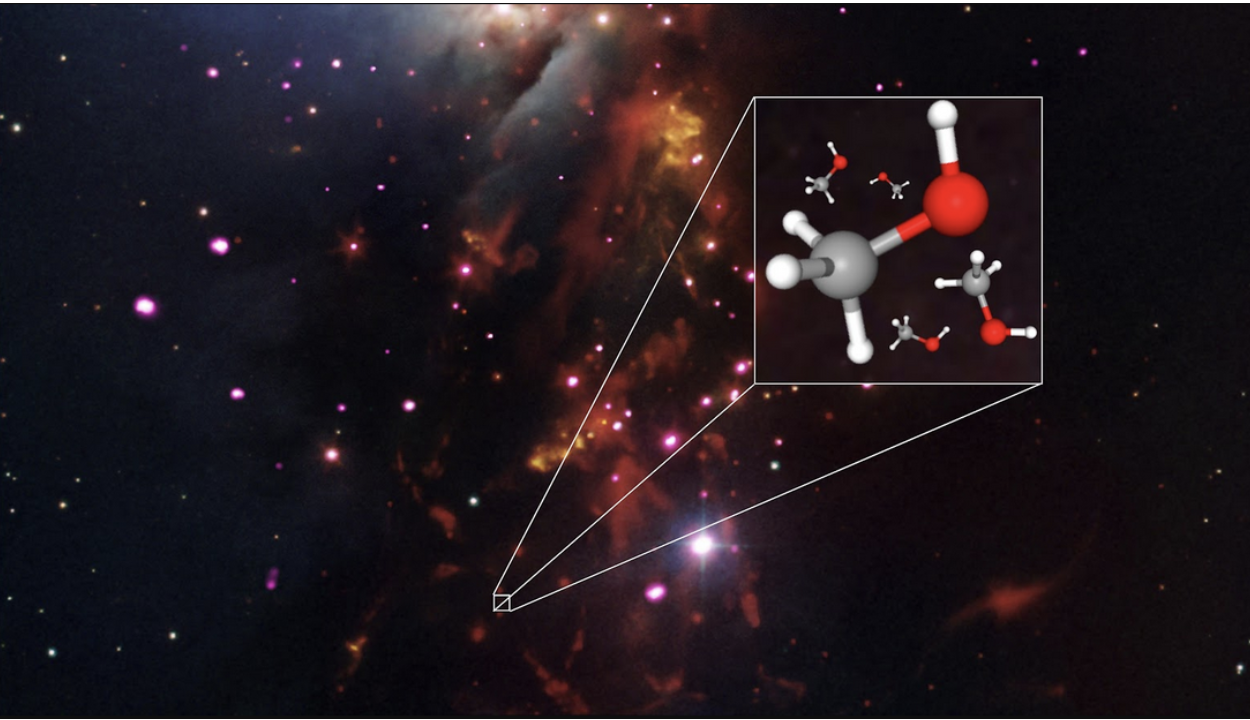
Image/Credit: This composite image shows the Perseus molecular cloud, located about 1,000 light-years from Earth. A rare form of the organic alcohol methanol has been observed around at least one of the very young stars still embedded within it. This is the first time this molecule has been detected in space, as reported by the ALMA COMPASS Large Program (Complex Organic Molecules in Protostars with ALMA Spectral Surveys). Credit: Ekaterina Moerova / MPIfR; Background: NASA, CXC, SSC, NOAO, DSS; 3D image of methanol: PubChem / National Center for Biotechnology Information.