

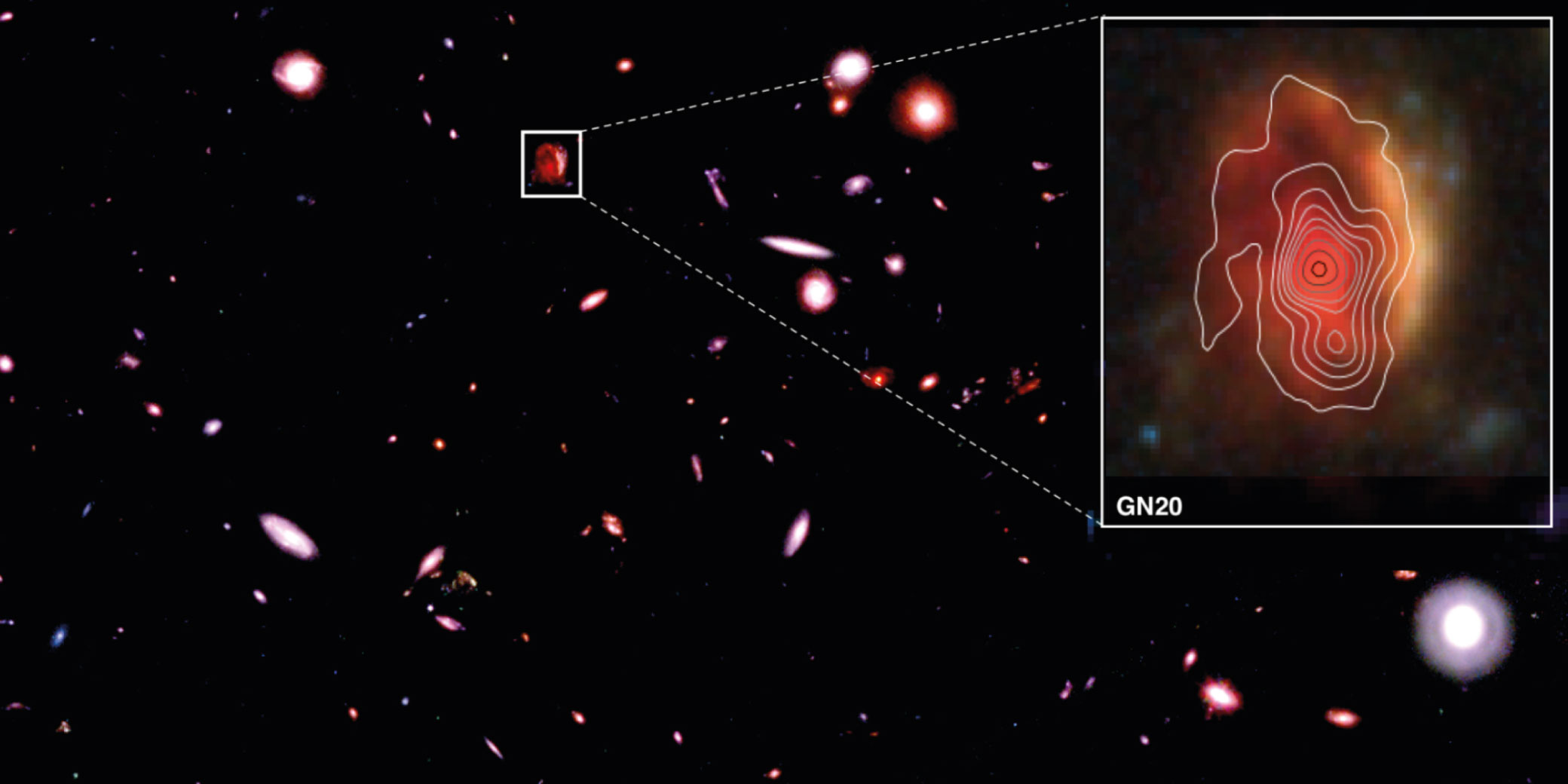
Combining observations from the NOEMA interferometer and the James Webb Space Telescope (JWST), astronomers have discovered a stellar bar in GN20, a massive, gas-rich starburst galaxy observed as it was only about 1.5 billion years after the Big Bang.
The discovery challenges classical models of galaxy evolution, which suggest that the large gas reservoirs common in the early Universe should inhibit bar formation. The NOEMA observations revealed a bar-like structure in the galaxy’s dust emission and an exceptionally large reservoir of cold molecular gas. Follow-up JWST observations uncovered a stellar bar closely aligned with this structure, providing new insights into how galaxies assembled and evolved in the early Universe.
The findings suggest that stellar bars can form rapidly even in extremely gas-rich galaxies, potentially driving material toward their centres, fuelling intense star formation and contributing to the growth of central supermassive black holes. Read the full IRAM article.
Image/Credit NASA/ESA/CSA James Webb Space Telescope. GN20 in GOODS-North field image from JWST Advanced Deep Extragalactic Survey (JADES) overlaid by NOEMA 1.1mm contours (white).