

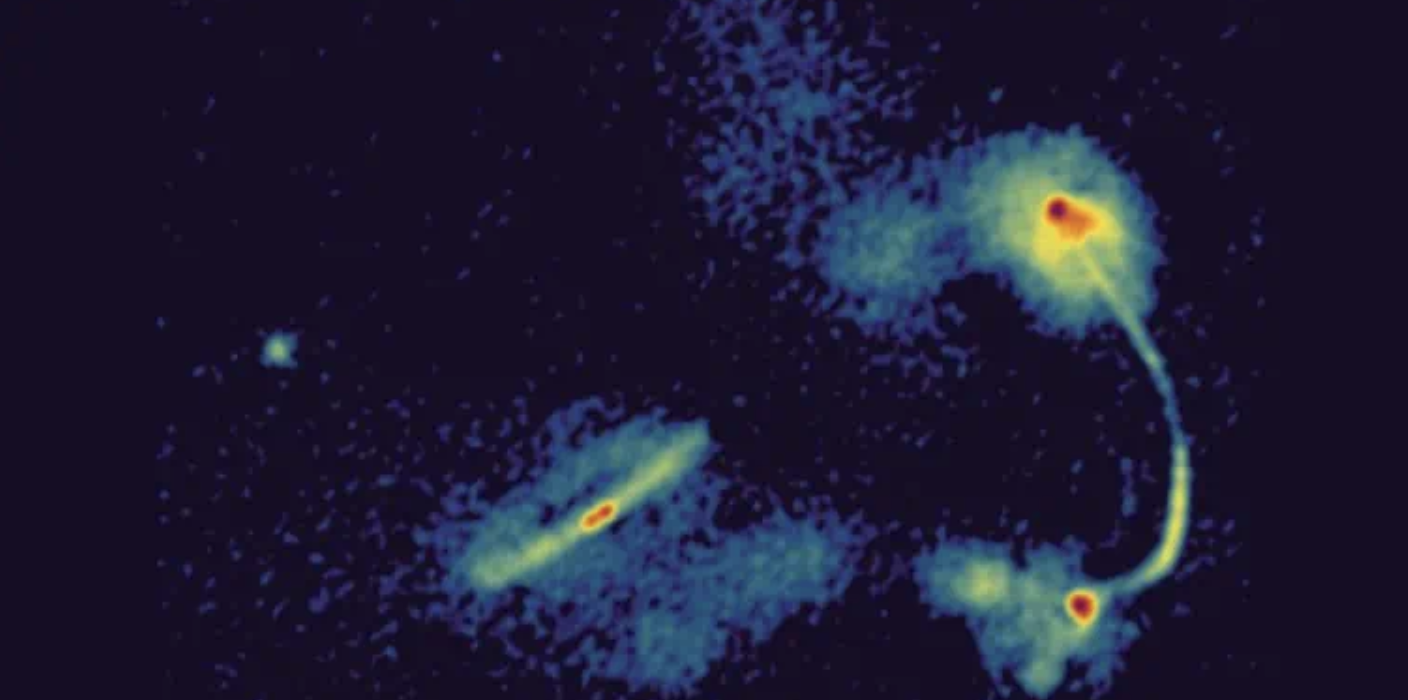
An international team led by Leiden University has produced the sharpest and deepest low-frequency radio image yet, detecting almost 63,000 radio sources across a region of the sky 25 times the size of the full Moon.
Based on 200 hours of observations and cutting-edge data-processing techniques, this remarkable achievement opens new opportunities to study distant galaxies, star formation and supermassive black-hole jets.
It also demonstrates the scientific potential of LOFAR2.0, paving the way for even more sensitive and wider-field observations in the era of the Square Kilometre Array (SKA).
Read the scientific publication: to be published in A&A (archive)
ASTRON press release: here
Image Credit: Three galaxies with radio emission. On the left, a compact source whose radio emission originates from active star formation. In the center, a radio jet with a bright core caused by a black hole. On the right, a curved jet. Credit: De Jong et al.