

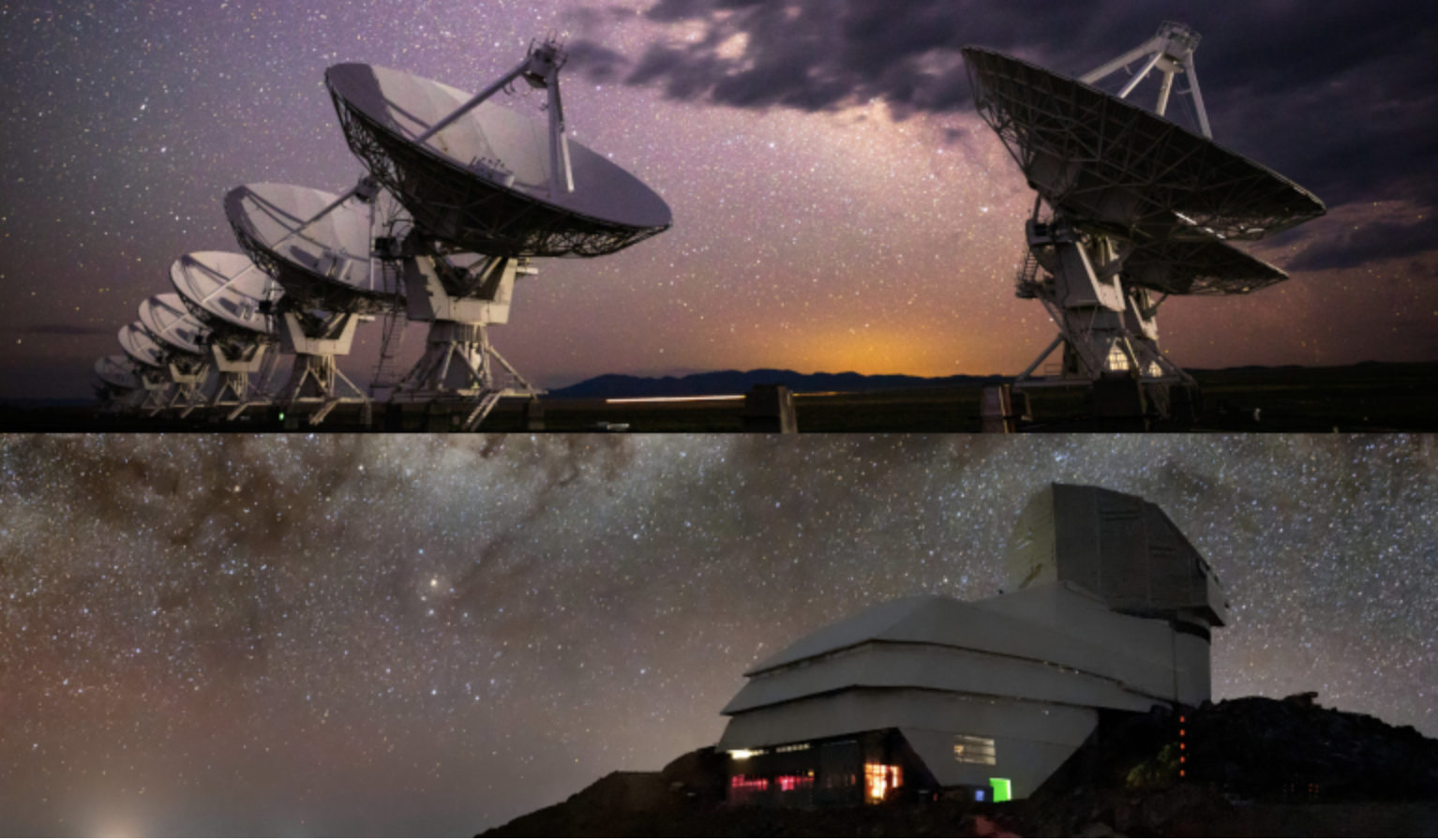
The NSF NRAO is offering non-proprietary VLA follow-up observations of community-selected Rubin Observatory Alerts on a best-effort basis, starting November 16, 2026. VLA Rubin Alert observations are aimed at detecting previously unobserved radio counterparts that appear on time scales of up to 72 hours after an optical detection with the Rubin Observatory. You will need to register for a NRAO account if you do not already have one if you wish to submit alert proposals.
To propose observations, visit the NRAO VLA Rubin Observatory Alerts page.
Submitted alert proposals will be evaluated for observation every day at 11:00 MT, and only alert requests that have been submitted to NRAO in the last 24 hours will be considered. VLA Rubin Alert proposals will not affect DDT and triggered proposal procedures.
Program details:
- The format of the observations is fixed, and the scheduling block is prepared by the Observatory. Observing is carried out using ~12.5 minute scheduling blocks at X-band (8-10 GHz) in Stokes I continuum, with an on-source time of up to 2 minutes. The flux calibration uses a switched noise diode, and the phase calibrator is automatically selected. The typical sensitivity achieved is ~30 uJy/beam, so sources with expected flux densities < 0.2 mJy are unlikely to be detected and will not be considered.
- If an alert is accepted for observation, it will be added to the VLA observation queue with a D-priority, and will remain in the queue for up to 48 hours. The VLA Rubin Alerts are observed as fillers between regular observations, and therefore not all accepted observations will be observed.
- Accepted alerts, their status (‘queued’, ‘observed’, or ‘expired’), and (if applicable) the pipeline-processed data and their archive identifiers will be posted. The scientific justification associated with the proposal and the submitter’s name will also be public on this alert webpage.
- The data from VLA Rubin Alerts do not have a proprietary period, and immediately will be made public in the NRAO data archive under the ALRT01 project code.
More information on the calibration of the data and the provided products can be found on the above page.
Please contact the NRAO Helpdesk and select the Rubin Alerts department with any issues encountered submitting a Rubin alert proposal.
Image credits:
NSF/AUI/NSF NRAO/B.Foott
NSF/Rubin Observatory/AURA/B. Quint